 Image 1 of 1
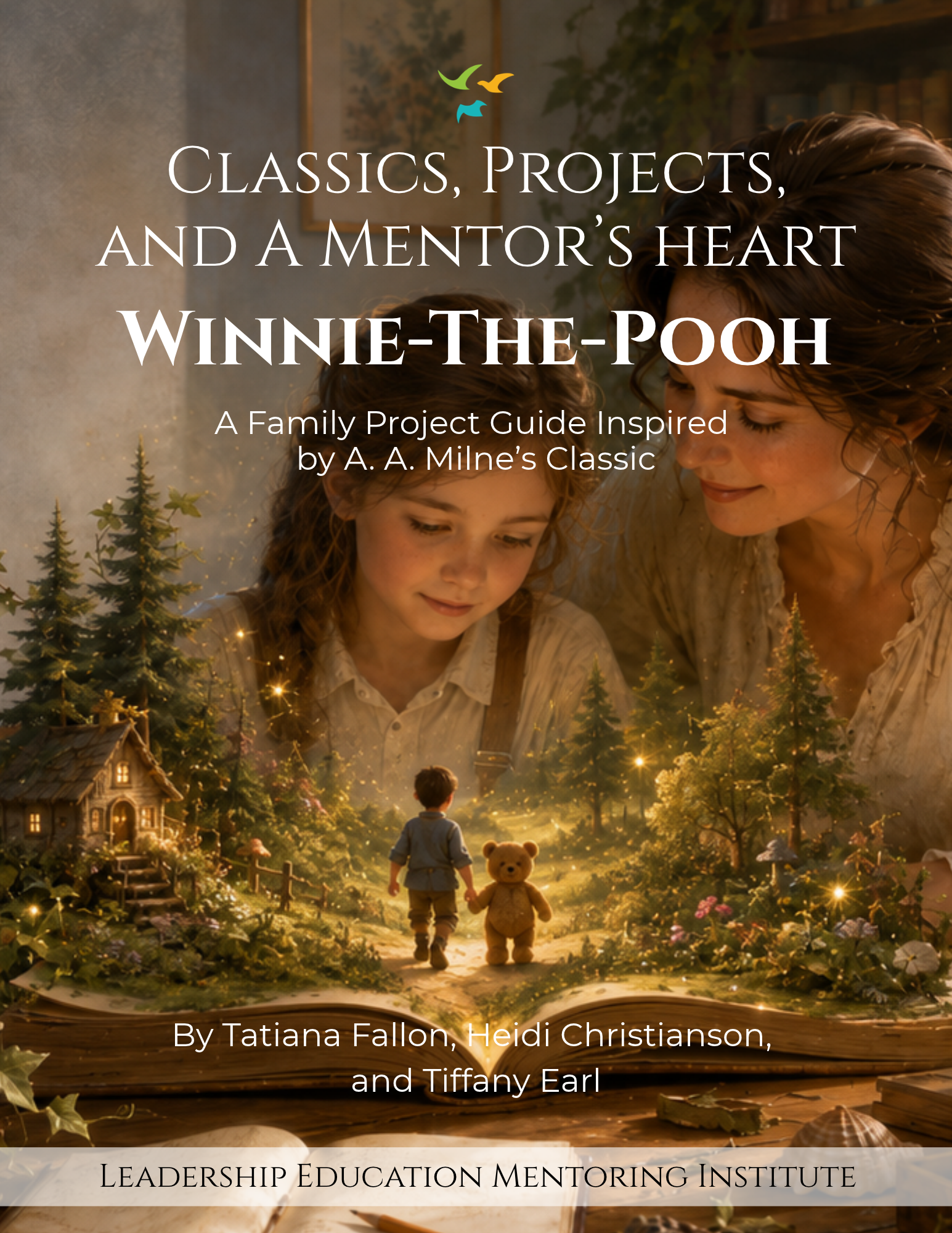
Classics, Projects, and a Mentor's Heart: Winnie-the-Pooh
A Family Project Guide Inspired by A.A. Milne's Classic
By Tatiana Fallon, Heidi Christianson, and Tiffany Earl | Leadership Education Mentoring Institute
Help your children find the big ideas hiding in a small, funny book.
You want all your children, from your youngest listener to your teen, to love great books, think for themselves, and keep gathering on the couch with you. With a little guidance, a good book can become the best part of your day, full of real conversation and ideas your children want to follow.
This is the book that gathers everyone, and older children love it too.
A bear of very little brain floats up to a bees’ nest on a balloon, gets stuck in Rabbit’s front door, and goes hunting for Woozles that turn out to be his own footprints. This guide covers all four of A.A. Milne’s original books: Winnie-the-Pooh, The House at Pooh Corner, and the poetry collections When We Were Very Young and Now We Are Six.
Milne wrote gently enough for a five-year-old and truly enough that a twelve-year-old, or a parent, keeps finding something new. Older children catch the wordplay and jokes that sail past the little ones, and they’re ready for the bigger questions underneath, like what it means to grow up. They can take a turn reading aloud to younger brothers and sisters, too.
Why this book
Small and brave. Piglet is frightened of nearly everything and brave anyway, even giving his own house to Owl. Children learn that courage doesn’t depend on size.
Loved as you are. Pooh isn’t the cleverest animal in the Wood, and he’s everyone’s best friend. That’s a comfort for any child who worries they aren’t quick enough.
Friendship and forgiveness. Christopher Robin reads to Pooh while he’s stuck, and the friends make Eeyore’s birthday happy even with a popped balloon. Children see what good friends actually do.
Imagination can become something real. Heffalump traps, expotitions, and a brand-new game called Poohsticks show children that what they dream up can turn into something they make.
Growing up without losing what you love. The books end with Christopher Robin growing up at the Enchanted Place, a tender way into talking about change as a family.
Along the way, you practice the skills of a mentor. The guide shows you how to ask questions that open a conversation, like asking “what” instead of “why,” and how to notice when play is the beginning of a project. With little ones, building with blocks or holding a stuffed bear while you read counts as listening.
A great book and a project are real learning. A single project pulls several subjects together. Building a relief map of the Hundred Acre Wood brings in geography, math, and art. Planning a real family “expotition,” with a route and a packing list, covers math and geography, and a honeybee model explains in science terms why Pooh’s rain-cloud disguise never had a chance. You can write down what each project covered after it’s done, for your records or for anyone who needs to see it.
How it works
Get the books. They’re easy to find at almost any library.
Read a session together. Older children can read aloud to younger ones.
When an idea won’t let go, help it become your child’s own project.
Inside: twelve reading sessions covering both story books, with the poems woven in and discussion questions for younger and older children; a guide to Socratic-style discussion; two printable Classic Bookmarks and a Family Quote Wall; activities from ten minutes to an afternoon; dozens of project ideas plus larger multi-day projects; and printable forms for planning, sharing, and keeping a session record.